‘Shiny points’ stand out
One of the key design principles of Shanzhai is to make the assets of the product stand out. Shanzhai is not about being subtle. It’s about bringing up the distinctive character of a product and accentuating it.
Of the population, “80-90% are unsophisticated consumers,” explains Wang, a Shanzhai mobile phone manufacturer. “When they buy a mobile phone, they want to see values that they can understand. They’ll not understand subtle design or complicated technology.”
Whether it’s a big camera lens or speakers attached to the phone, these consumers want focal points, because they are the “face” of products. Chinese consumers call this quality liangdian, or “shiny points,” in the design. These exaggerated features attract the attention of others and explicitly state that those are what consumers have paid money for. Products become valuable partly through the confirmation of one’s peers.
How might companies design for liangdian, or shiny points?
The optimism of humor
Li is saving money to buy a QQ, the Shanzhai version of the economical GM Sparkle. He plans to customize it with a “Mercedes emblem.”
“It’s the Mercedes of ordinary folks,” says Li with a laugh. “With this car I will be a true ‘successful businessman’ like my mom always brags to her fellow villagers!”
A young migrant worker with only a high school diploma, Li is doing well to have found a job as a clerk in Shenzhen, but he is nowhere near the popular image of the “successful businessman” who gets driven around in a Mercedes. QQ adds color to everyday life by making fun of ordinary people’s reality. It’s the grassroots humor of Shanzhai culture that attracts consumers like Lee — people who work hard, whose lives are improving, and who are optimistic about the future.
How might brands get closer to ordinary people by using their sense of humor?
Legitimacy through participation
“Lecture Hall” is a well-known program on CCTV, the biggest national television network in China. It features scholars discussing various topics, from history to literature to art. Han is a businessman with a strong interest in history. Through CCTV’s application procedure, Han expressed his interest in offering a series of talks about the Song Dynasty but was told he was not qualified because he is not a professor. So he decided to make a Shanzhai version of “Lecture Hall” in a simple studio he set up.
Han posted his video on the Internet, and within weeks, the show had been watched more than half a million times. This quintessentially Chinese story reveals the strong need for popular participation and local legitimacy.
How might we create a platform where ordinary people feel comfortable adding a bit of themselves to the product?
The word shanzhai…
Made up of the characters shan (山, “mountain”) + zhai (寨, “fortress”), Shanzhai implies banditry and lack of state control. The phrase suggests the value that runs through Chinese classics like Water Margin, the story of bandits who helped the poor by stealing from the rich. In this Chinese version of Robin Hood, “right” and “wrong” are presented in an ambiguous light. In this respect, perhaps, Shanzhai questions legitimacy and authenticity of design and blurs the line between cultural appropriation and outright theft.
Leveraging grassroots innovation
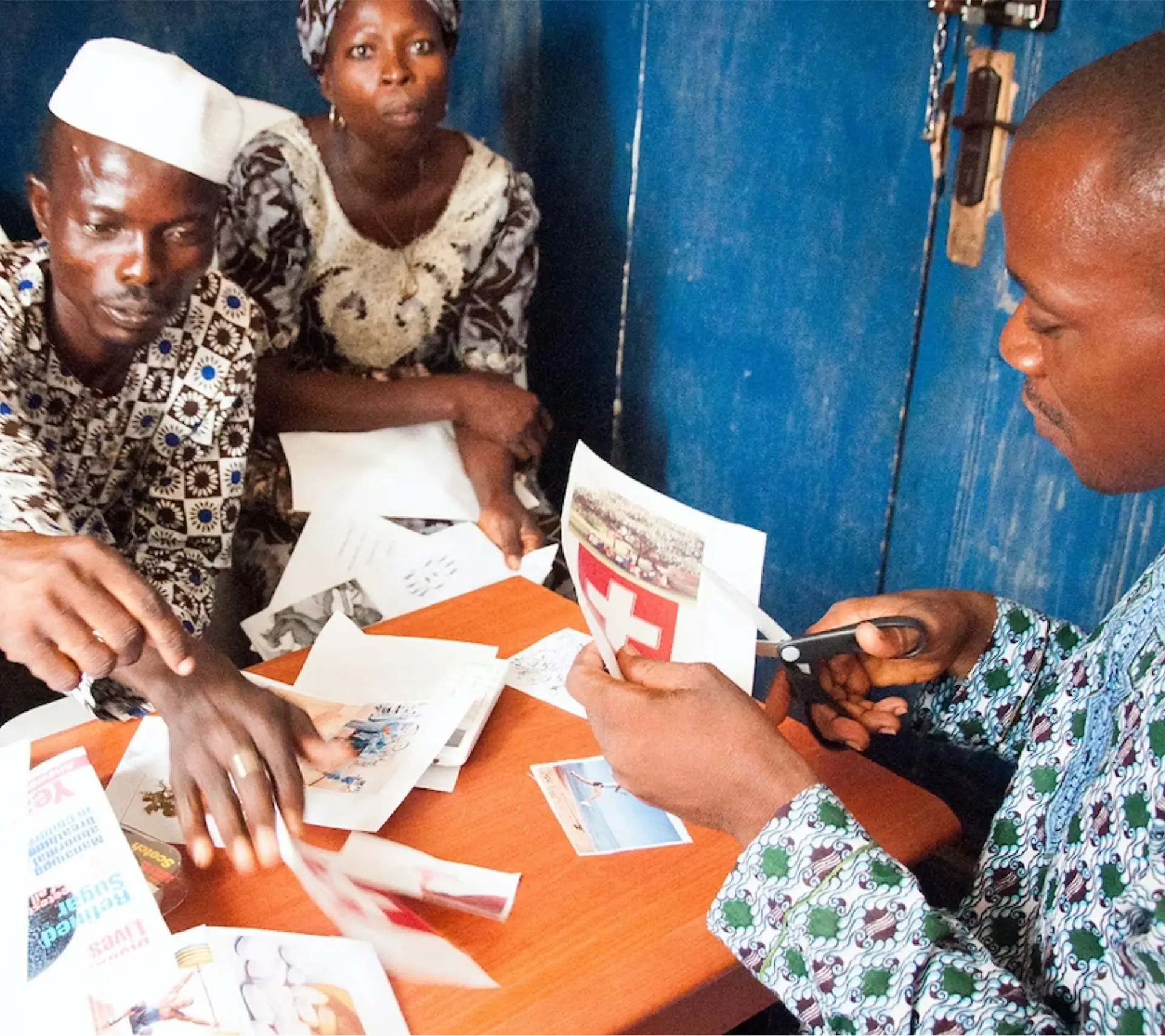
Nokia recognized how Shanzhai can help us learn about other cultures when it created a design competition in three communities far beyond China: Dharavi (Mumbai, India), Favela Jacarezinho (Rio de Janeiro, Brazil), and Buduburam (Accra, Ghana). Nokia’s “temporary design studio” is about learning how people improvise, use, and conceptualize a device in the context of their own communities. The open studio provided an alternative way for people to articulate their wants and needs.
Prototyping rather than planning
Shanzhai mobile phones have at least 2 SIM card slots. This may not be an award-winning design concept, but it effectively addresses the needs of Chinese users who often use an additional local number when they travel. Shanzhai is about implementing user needs in a short period of time. It runs on the spirit of “put it out there and see how it goes.” Production cycles are very short and quality may be compromised, but over time the product is improved and becomes more stable.
Fake star or entrepreneur?
There are many Shanzhai stars in the Chinese media, but in contrast with Elvis impersonators in the West, they are quasi-legitimate. Some, like Andy Lau and Jay Chou, are considered quite successful in their own right and have been invited to perform at local events. Embracing Shanzhai has created a business opportunity for performers to utilize their lookalike asset and build authentic fame. These impersonators have value for being Shanzhai, rather than because they can impersonate famous stars.
sally madsen
February 17, 2010
I love these examples! One compelling design challenge is to enable companies like Nokia and Samsung to learn from these grassroots innovations, and share the solutions with other markets.
205 people agree with this comment
Agree | reply
Woodear Z. Wang
February 24, 2010
Hi, Sally, ShanZhai is actually a perfect example about how to design for the BoP market (which I guess you are into) in China. Big companies do brainstorming in their design process, here, at grass root, people do prototype-storming…
It would be really interesting to compare Nokia 1100’s global success and MTK (a Taiwanese company which produces the motherboards)‘s success inside China. Do it yourself or create a platform and enable everyone at the grass root to make a fortune?
202 people agree with this comment
Agree | reply